
Why Do Automotive Relays Need to Be Tested? Testing can ensure, with a high degree of certainty, product consistency across each batch of relays, thereby improving the stability of control systems and facilitating maintenance and replacement.
It also verifies the performance and durability of relays, using pass rates as a standard to reduce the likelihood of electrical failures and other issues in relays shipped from the factory or sold to customers.

1. What Is Automotive Relay Testing?
Using a variety of equipment and methods, we verify the electrical performance, mechanical performance, environmental resistance, product lifespan, and reliability of automotive relays. This helps determine the appropriate applications for relays with different performance characteristics, ensures consistent product quality during sales, and reduces the occurrence of post-sale issues and maintenance costs.
1.1 What Does Automotive Relay Testing Evaluate?
| Dimension | What It Evaluate | Main Purpose |
| Electrical | Coil and contact performance | Rated Current or Maximum Current |
| Mechanical | Switching and mechanical durability | Number of times it can move |
| Environmental | Temperature, humidity, vibration, etc. | Installation Location and Method |
| Reliability | Long-term operating performance | Product Lifespan |
1.2 Automotive Relay Testing vs. Basic Relay Testing
Compared to basic relays, automotive relays typically require greater vibration resistance, and due to the significant heat generated by the engine, they generally need to withstand higher temperatures. Electrical components such as hazard lights also put automotive relays to the test in terms of their ability to switch on and off frequently.
2. What Should Be Tested in an Automotive Relay?
| Test Category | Key Tests |
| Visual | Appearance, marking, housing |
| Dimensional | Dimensions, terminals |
| Coil | Resistance, pickup, dropout |
| Contact | Resistance, voltage drop |
| Insulation | Insulation resistance, dielectric strength |
| Switching | Operate time, release time |
| Mechanical | Mechanical endurance, terminal strength |
| Environmental | Temperature, humidity, vibration |
| Electrical Endurance | Load switching, electrical life |
| Reliability | Long-term durability |
3. Automotive Relay Electrical Testing

3.1 Coil Resistance Test
Typically, you can measure pins 85 and 86 to determine the coil resistance and, based on any abnormal results found during testing, decide which method to use to resolve the issue. This is not only used for repairs but is also an important quality control measure during production and acceptance testing.
3.2 Pickup & Dropout Voltage Test
The voltage in a moving vehicle fluctuates constantly due to various factors. To ensure reliable relay operation, the release voltage and pickup voltage must remain within the designed voltage range; voltages that are too high or too low are not necessarily desirable.
3.3 Contact Resistance Test
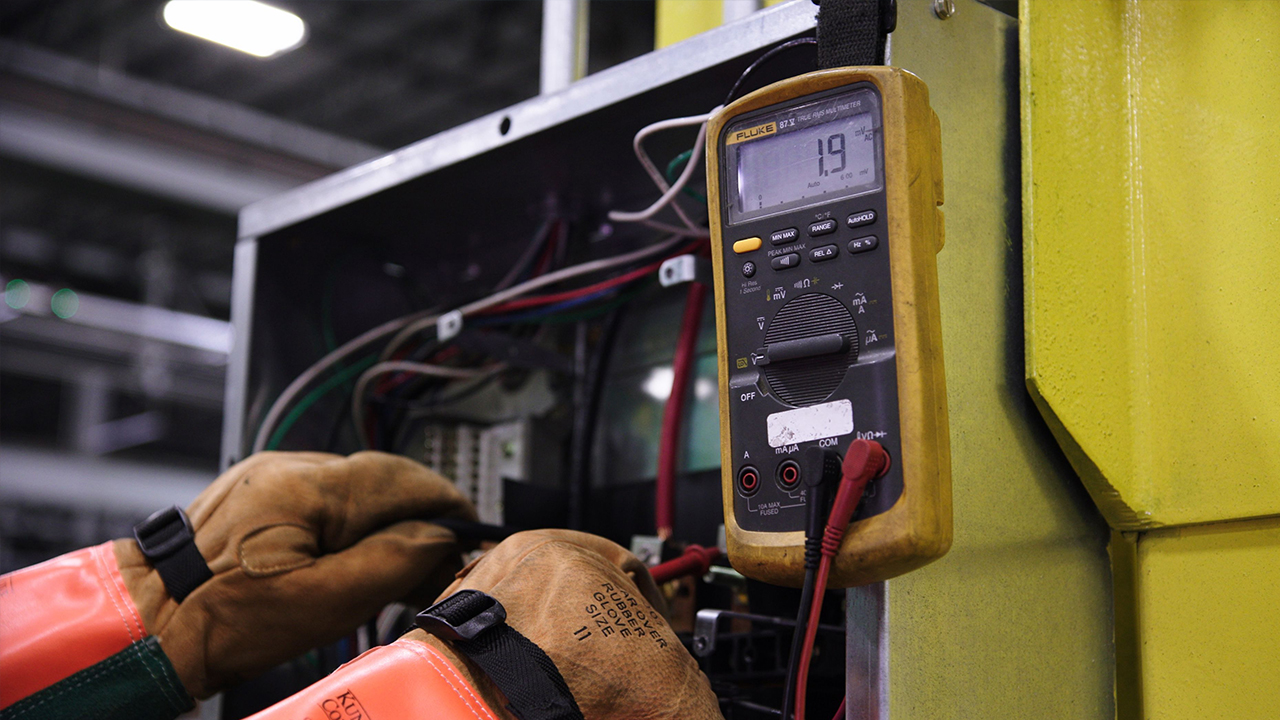
Contact resistance testing is performed to verify the conductivity of the contacts and prevent contact resistance from increasing over time or due to operation. You need to select the appropriate contact material based on the application.
Since contact resistance affects the actual voltage across the load and the heat generated by the contacts themselves, it can compromise the reliability of relay operation. In high-current circuits, it may even pose a significant hazard due to the contacts melting as a result of overheating.
3.4 Insulation Resistance Test
As a precision electronic component, an automotive relay houses both control and load circuits within such a confined space; good insulation resistance can effectively reduce leakage current and enhance the electrical reliability of your entire control system.
4. Automotive Relay Mechanical Testing
Essentially, these types of tests can be categorized into dynamic performance, static performance, and reliability. Based on these values, you can clearly determine where this batch of relays can be used and whether they will affect the stable operation of the entire control system.
| Test | Purpose | Effect |
| Operate Time | Verify the time required for the relay to switch after energization | Ensures switching occurs within the specified response time |
| Release Time | Verify the time required for contacts to return after de-energization | Ensures the relay releases within the specified time |
| Contact Bounce | Stability After Repeated Relay Operations | Excessive bounce time can cause arcing or accelerate contact wear. |
| Contact Force | Verify whether the contacts can maintain a reliable electrical connection | Poor contact can lead to increased resistance, which consumes more electrical energy and generates heat. Excessive pressure can also cause increased wear. |
| Mechanical Endurance | Verify the long-term operational capability of the entire mechanical assembly | The use cases for relays can be determined based on experimental data. |
| Terminal Strength | Verification of the Mechanical Properties of Terminals | You can expect a longer service life. |
| Mounting Strength | Verifying the Reliability of Relay Installation | Automotive relays, in particular, require a reliable design and secure mounting to prevent them from becoming loose or dislodged from their mounting positions. |
5. Automotive Relay Environmental Testing
High- and low-temperature testing is a very common method for verifying whether a relay can function properly at specific temperatures. Typically, you should conduct high-temperature test, low-temperature test and temperature cycling tests to determine the stability of the relay’s internal materials and structure.
Salt spray testing evaluates the stability of the relay’s various materials, while vibration testing simulates the effects of vehicle motion on the relay’s operation.
6. Automotive Relay Electrical Endurance and Reliability Testing
“Will this automotive relay withstand long-term use without failing?” This is a question that often comes to mind whenever we handle a relay. We usually need to conduct some electrical endurance tests to fully understand its performance, including:
- Rated load
- Switching cycles
- Switching frequency
- Duty cycle
- Load type
It is also necessary to conduct lamp load testing to verify how the relay’s switching capacity is affected by varying switching stresses under different load conditions.
There are also two very important tests: the inductive load test and the resistive load test. You must distinguish between these two tests based on whether the load can store energy.
Under specified test conditions, the resistive load test evaluates whether the relay’s current-carrying capacity and thermal performance fall within the specified rated values, while the inductive load test evaluates the relay’s switching stress, arc resistance, and contact endurance.
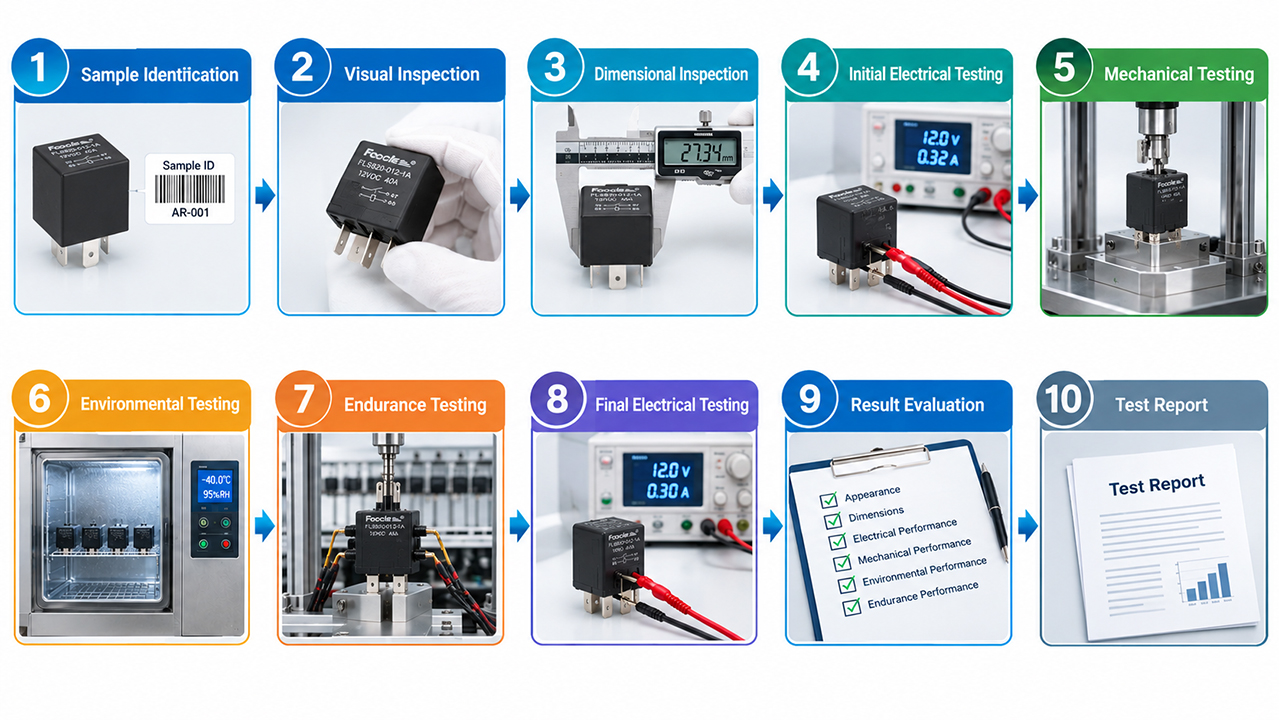
7. Automotive Relay Testing Procedure
Different automotive relays have specific test items that are emphasized; the following are the standard test procedures for ISO relays:
8. Automotive Relay Testing Standards
Testing of automotive relays may involve various standards, many of which draw heavily on the IEC 61810-1, ISO 7588-1, and ISO 16750-2. Please note that no single standard can fully cover all tests with specific numerical criteria; rather, the specific conditions and OEM requirements must be considered. In some cases, there may be no standard at all, and testing is based solely on the customer’s specifications.
Automotive Relay Testing Standards Table
| Standard | Main Scope | Relevant Relay Testing | ||
| IEC 61810-1 | Electromechanical relay general/safety requirements | Functional, electrical, insulation, endurance-related tests | ||
| IEC 61810-2 | Relay reliability | Endurance/reliability evaluation | ||
| ISO 7588-1 |
| Dimensions and terminal functional allocation | ||
| ISO 16750-2 | Electrical loads | Electrical environmental/load conditions | ||
| ISO 16750-3 | Mechanical loads | Vibration/mechanical loads | ||
| ISO 16750-4 | Climatic loads | Temperature/humidity/climatic testing |
9. Common Automotive Relay Testing Failures
You can refer to this information to help resolve some after-sales issues.
| Failure | Common Causes | Main Consequences |
| Coil Resistance Failure | Broken coil wire, shorted turns, poor internal connection, temperature variation | Abnormal coil current, excessive heating, or relay operating failure |
| Pickup Voltage Failure | High coil resistance, weak magnetic circuit, excessive spring force, mechanical friction | Relay fails to operate at specified voltage |
| Dropout Voltage Failure | Residual magnetism, armature sticking, excessive contact force, mechanical friction | Relay fails to release correctly |
| Contact Resistance Failure | Oxidation, contamination, wear, corrosion, low contact force | Voltage drop and heat generation |
| Contact Welding | Excessive current, inrush current, inductive load, arc energy, overheating | Contacts remain permanently closed |
| Insulation Failure | Moisture, contamination, insulation damage, over-voltage, aging | Leakage current or dielectric breakdown |
| Vibration Failure | Loose terminals, component fatigue, poor mounting, contact misalignment | Intermittent connection or mechanical damage |
| High-Temperature Failure | Excessive current, coil heating, high contact resistance, material aging | Parameter drift, deformation, insulation degradation |
10. Frequently Asked Questions
10.1 How Many Samples Are Needed for Automotive Relay Testing?
The sample size required for testing depends on the type of test, the purpose of the test, the total quantity, customer requirements, and other factors.
The sample sizes required for sampling tests during routine production differ from those required for design verification tests. For reliability and endurance tests, statistical requirements and confidence levels must also be taken into account.
10.2 What Is the Difference Between Type Testing and Routine Testing for Automotive Relays?
Type testing is generally performed to verify whether a relay design meets specified performance, safety, environmental, and endurance requirements. It is typically associated with design qualification or approval.
Routine testing is performed on production units or batches to verify that manufactured relays continue to meet specified requirements and maintain consistent quality.
10.3 How Do You Compare Automotive Relay Test Results from Different Suppliers?
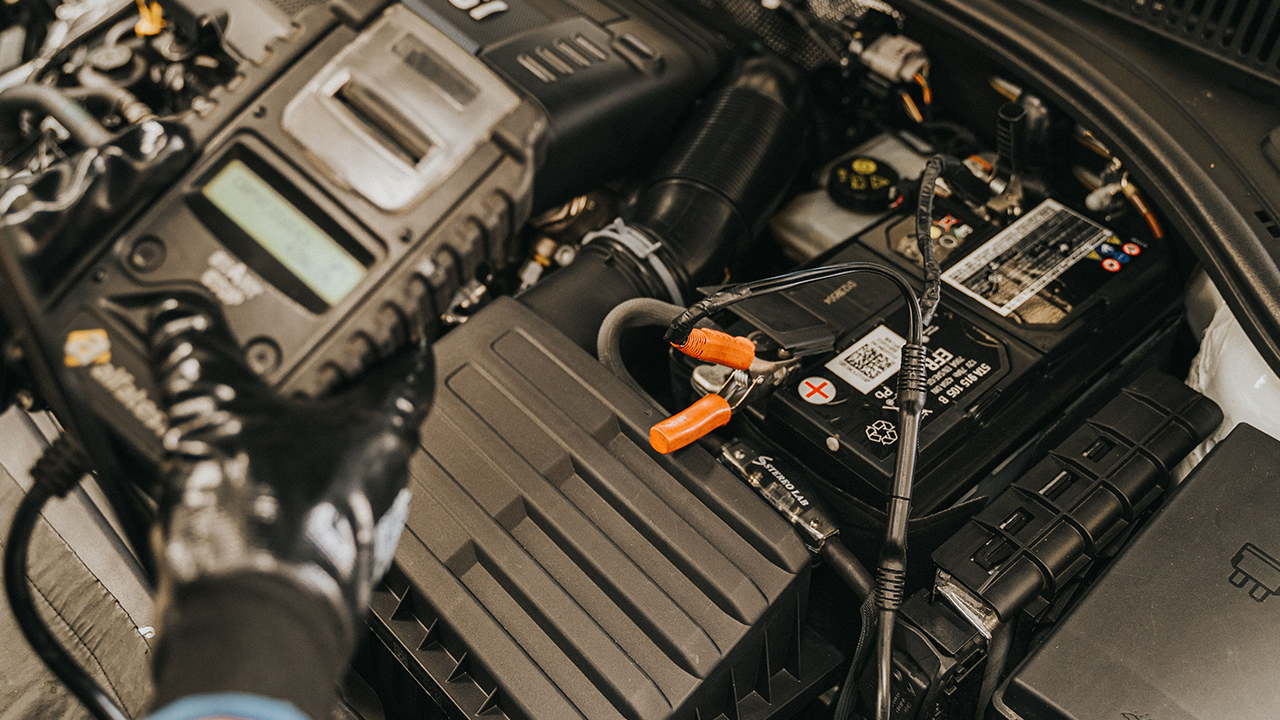
Even for the same relay, test results may vary under different conditions, so a simple side-by-side comparison isn’t possible. Common factors include temperature, which affects resistance, and the duration of power application, which affects temperature. You must clarify the comparison conditions before making any comparisons.
10.4 Can an Automotive Relay Pass Testing but Still Fail in a Vehicle?
This is a possibility. Tests are typically conducted in a controlled environment, whereas in actual use, factors such as vibration, voltage fluctuations, inrush current, inductive loads, and connector conditions cannot be precisely controlled. Therefore, the test range is usually much wider than the actual operating range to allow for a margin of safety.
10.5 How Do You Set Acceptance Criteria for Automotive Relay Tests?
There is no universal acceptance criterion. It is necessary to take into account the customer’s requirements, the product’s specifications, the needs of the actual application, and the relevant industry standards. This ensures that, once testing is passed, the majority of products will perform well under actual operating conditions.
10.6 What Test Documents Should an Automotive Relay Supplier Provide?
- Test report
- Product specification
- Reliability test report
- Material certificate
- Inspection report
- Calibration records
- Certificate of conformity
- PPAP documents, when applicable
- Customer-specific documentation
10.7 How Many Ohms Should a 24V Relay Have?

There is no universal resistance value for all 24V relays. The resistance of a 24V relay depends on the manufacturer’s specifications, rated power, and current. Its resistance can be roughly estimated using the formula R = U/I. As long as the measured resistance does not deviate significantly from the specified range, the measurement is considered normal; extremely high or low resistance indicates a fault.
10.8 How to Test an Automotive Relay with a Multimeter?
A multimeter is commonly used for troubleshooting during repairs, including identifying relay terminals, measuring resistance, and checking for continuity, to provide a basis for determining the next steps in the repair process. At the same time, care must be taken when switching between modes to avoid applying a voltage that exceeds the relay’s rated voltage.
Get More Testing Help From Foocles
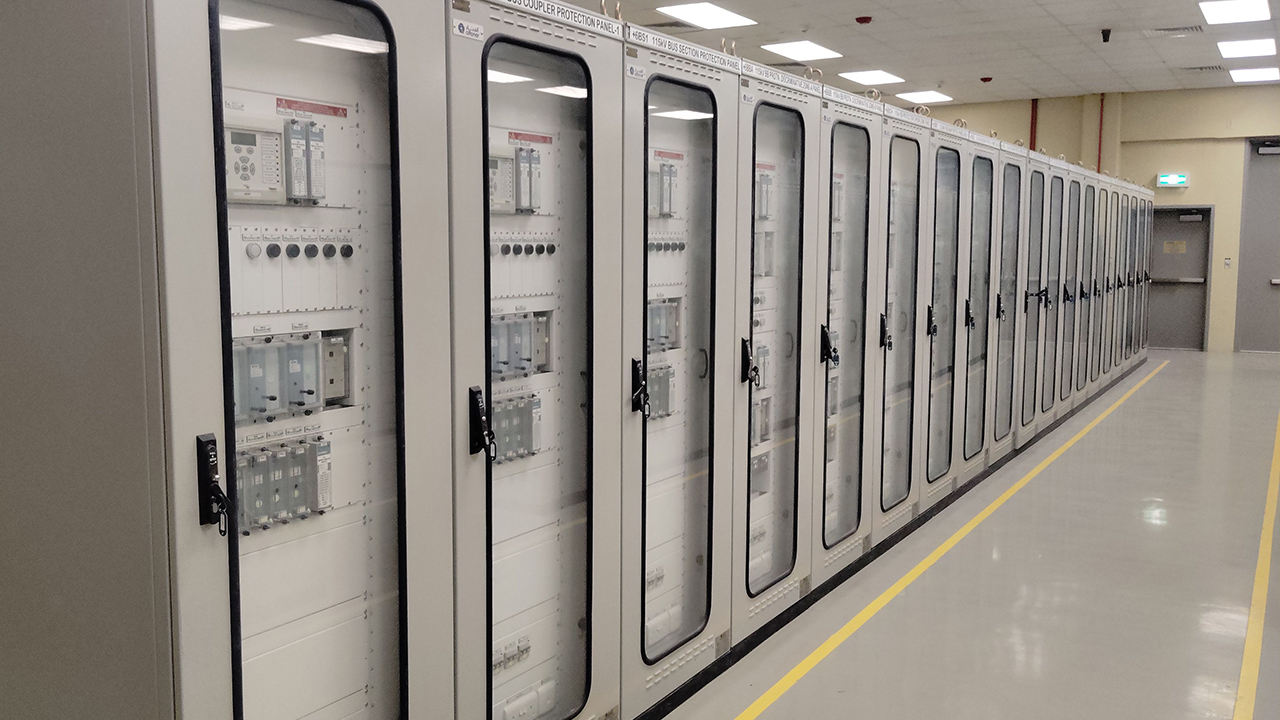
Foocles is a manufacturer with over 15 years of experience in producing automotive relays. We are equipped to conduct a wide range of tests, including type testing, routine testing, production testing, acceptance testing, and reliability testing. Contact us and use our automotive relays to receive a comprehensive test report for analyzing product feasibility options.

